Showing posts with label religion. Show all posts

Saturday, April 13, 2013

Being Hindu is to stop being fanatical....


Being Hindu is to stop being fanatical…it is being cosmopolitical

Advaita Vedanta of Sri Shankaracharya ( circa 780 AD – 820 AD), Shaivism with its many branches,Vaishnavite systems with their deism, the Tantric system with its own inner esoteric logic, the neo-Vedanta of the Ramakrishna Order and the lived daily lives of countless wo/men with their sacred rituals have come to mean for us Hinduism. Some of us live by the philosophy of Sri Ramanujacharya (circa 1017 AD – 1137 AD); some of us try to integrate within us the teachings of Patanjali (circa 2nd BC) while again some among us would want to live by the dictum of Sage Vashishtha. We are a Faith community which has no one language; our practitioners may appear unrecognizable to each other, leave alone to the devotees of other religions. We have no one book to live by; we accept no one centralized source of doctrines. In truth, we have only our own inner loci of control to lead us to God. Our concept of the universe has been mistakenly confused with the philosophy of pandeism (sic). In fact, we are a community evolving with the times. Our concept of dharma does not mean only a specific cognitive space or an area of discourse which separates our lives into little-boxes and relegates the idea of the holy to the realm of what is commonly understood by spirituality. Our religion is a lived religion which sees natural ambition for earning wealth, having sex within marriage, and having fulfilling careers to be integral to self-actualization. Thus, Hinduism is a religion which is eminently practical and does not concern itself too much with the life to come. It is enough to enjoy and live this present life to the full. It is only within Hinduism will one find an equal stature being given to the householder and the renunciate. Both can and do attain God. In all other religions of the world, the renunciate is compulsorily seen as superior to the layperson. In all probability the apaurusheya Upanishads and the Vedas relate the lived-experience of non-celibate happily wedded seers, both women and men. Those who seek Hinduism for magic, for personal peace, for some sort of harmony and certainty, seek in vain. Their quest is misplaced. Hindus know that to be spiritual is to be uncertain, to desire holiness often immature, to seek magic and miracles may be non-scientific and betray a need to find quick-fix solutions to real problems which need long working out. To seek peace in a world torn by strife is foolishness and moreover, selfish. How can a spiritual person seek inaction and solipsism when countless around her or him are illiterate, hungry and live with no proper sanitation? Hinduism rejects these desires as been unworthy of the human being. This world is not meant to be a seclusion: it is meant to be one of action, and relentless self-appraisal: am I fighting the good fight? Am I living my swadharma?

(Read the rest of the editorial here : Lectio Divina )


This was a very eye-opening article and I feel that it has much merit, at least for me. Would love to know any thoughts on it!

Jai Maa,
Nirvani

Thursday, November 15, 2012

White Hindu Converts: Mimicry or Mockery? (Article)


  White Hindu Converts: Mimicry or Mockery?

 Here is an article published in the Huffington Post regarding White Westerners converting to Hinduism and mimicking  the stereotypical or 'imagined' archetype of Indian Hindu culture. I will say for myself, that first off I did not just choose to embrace Hinduism...it chose me. Why should I go against what I feel in my heart and soul is my Dharma. It has nothing to do with my culture or the Indian culture. I believe very deeply in the philosophy of Sanatana Dharma, Vedanta to be precise. Should I call myself a Hindu? I doubt myself every day. I ask myself all the time if I am somehow just pretending, but then I read Hindu scripture or words from Hindu gurus and it dissolves my doubts for a time. I do not question the philosophy, what I question is do I belong in the Hindu culture. I know in India Hinduism pervades ever aspect of life both religious and secular...where in the United States religion is thought of as aside from secular life.
      I would in no way mock Hinduism...at least not intentionally and it troubles me to think that Hindus would even think that of me. Yes I would like to fit in with them, but I do not feel the need to do it just to claim that I am a Hindu. My spirituality is very personal to me and no one...absolutely no one can take that from me. I still embrace my own culture, and am working to integrate parts of my new Hindu beliefs into my own culture at home. I am always looking to those born into Hinduism for guidance. Those I have met online have been very welcoming and honestly quite loving...they have no idea how grateful I am for that.
     I feel as if I am part of something bigger in respect to being one of the few Western Hindus out there, and with that I feel a great responsibility in living a Hindu life that bares integrity and genuineness. I know I have a good following of Hindus out of India here on my blog and am always open to discussion...and would love to hear from many of you and what your thoughts may be on this matter. I look at each of you as my brother and sister in Dharma.
      If Vedanta was not meant to be spread throughout the world then great men like Swami Vivekananda and Paramahansa Yogananda would never have brought it to the West. Hinduism culturally may not be for everyone, but who holds claim to Vedanta? It is what every human being is...it is our birthright.

Tat Tvam Asi,
Nirvani


Friday, October 26, 2012

Prayer is Timeless....

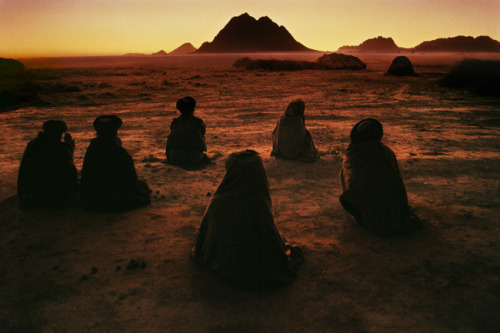
(Photograph: Steve McCurry, Kuchi Nomads, Evening Prayer, Kandahar, Afghanistan, 1992)

In prayer, we come nearest to making a real clearance in the thicket of thought. Prayer takes thought to a place of stillness. Prayer slows the flow of the mind until we can begin to see with a new tranquility. In this kind of thought, we become conscious of our divine belonging. We begin to sense the serenity of this clearing. We learn that regardless of the fragmentation and turbulence in so many regions of our lives, there is a place in the soul where the voices and prodding of the world never reach. It is almost like the image of the tree. The branches can sway and quiver in the wind, the center of the tree, there pertains the stillness of its anchorage. In prayer, thought returns to its origin in the infinite. Attuned to its origin, thought reaches below its own netting. In this way prayer liberates thought from the small rooms where fear and need confine it. Despite all the negative talk about God, the Divine still remains the one space where thought can become free. There we will be liberated from the repetitive echoes of our own smallness and blindness… Prayer is the path to the secret belonging at the heart of our other lives.

John O’Donohue from Eternal Echoes


    This is one of the most beautiful representations on prayer I have ever read. Prayer is not so common a word used among modern western spiritual thinkers. My perspective is that many people in our day have become disenchanted with orthodox religion  and tend to associate prayer with dogma. This could not be further from the truth in my opinion. For me, prayer is as essential as meditation to connecting and merging with the Divine. Prayer is talking to God/Goddess/Universe to convey some desire hoped for or expressing gratification for desires met. Spoken affirmations can also be considered a kind of prayer. Meditation, on the other hand, involves no action other than listening and just being. Unfortunately due to narrow-minded thinking prayer has been branded as religious and meditation as irreligious yet spiritual. In truth, prayer and meditation when used together, create a harmonious song of Oneness in the soul.

Jai Mata Di,
Nirvani